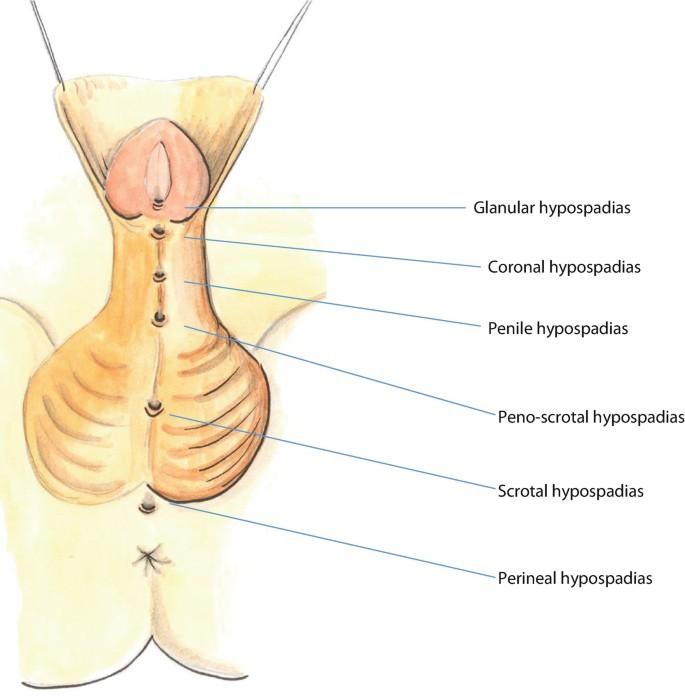
Hypospadias is a congenital condition in which the urethral opening is on the underside of the penis. The position of the opening can vary from just below the tip to further down the shaft or near the scrotum.
Features of Hypospadias?
- Urethral opening on the underside of the penis
- Downward curvature of the penis (chordee)
- A hooded or incomplete foreskin, with more foreskin on the upper surface
- Abnormal direction or spraying of the urine stream
- Difficulty directing urine while standing in some cases
The severity varies from mild to more complex forms.
Types of Hypospadias
1. Distal Hypospadias
- Glanular
- Coronal
- Subcoronal
2. Midshaft Hypospadias
3. Proximal Hypospadias
Does Hypospadias Need Treatment?
Treatment depends on the severity.
Mild hypospadias without significant curvature may sometimes cause few problems. However, surgery is commonly recommended when there is:
- Significant abnormal position of the urethral opening
- Penile curvature
- Abnormal urinary stream
- Difficulty urinating while standing
- Cosmetic or functional concerns
Surgery
TIP urethroplasty (Snodgrass procedure)
MAGPI in selected distal cases
Onlay flap procedures
Two-stage urethroplasty for selected severe or proximal cases
Frequently Asked Questions
Did we do anything to cause our child's hypospadias?
No. Hypospadias is a congenital condition and is not caused by anything parents did or did not do.
Can a child with hypospadias urinate normally?
Many children with mild hypospadias can urinate normally. More severe cases may have an abnormal or spraying urinary stream. Surgery can improve urinary function when needed.
Will my child need circumcision?
Do not circumcise a child with hypospadias before seeing a pediatric urologist. The foreskin may be needed during certain types of hypospadias repair.
When is Surgery Usually Performed?
Hypospadias repair is commonly performed during infancy or early childhood, often around 6–18 months of age, depending on the child's condition, the type of hypospadias, and the surgeon's preference.
More complex cases may require individualized timing and sometimes more than one operation.
Will surgery affect future sexual function?
Successful repair generally aims to provide a straight penis and a normally positioned urethral opening. Most children do well, although severe cases may require long-term follow-up.
Can hypospadias affect fertility?
Most men with mild hypospadias have normal fertility. Severe proximal hypospadias, particularly when associated with other genital abnormalities, may require additional evaluation.
Will one operation be enough?
Many children with distal hypospadias require only one operation. More complex or proximal cases may require staged surgery or additional procedures.
Contact:
Dr Arun Shah
MCh Urology
National Urology Center, Janakpur
9744427743